- General
- 6 min read
- By George Burchell
- View publications on PubMed
- ORCID
Introduction to Systematic Reviews
🔍 Casting a Wide Net in the Ocean of Literature
A systematic review represents the gold standard in evidence synthesis. Unlike traditional literature reviews, systematic reviews aim to cast a wide net in the vast ocean of research literature to comprehensively answer a specific research question. The methodology is rigorous, transparent, and designed to minimize bias at every step.
💡 Pro Tip: A well-conducted systematic review sits at the top of the evidence hierarchy, providing the most reliable foundation for evidence-based practice and policy decisions!
📋 The Six Essential Steps of Systematic Reviews
1️⃣ Research Question Design & Protocol Development
Every systematic review begins with a clearly defined research question. This question should be specific, measurable, achievable, relevant, and time-bound (SMART). Common frameworks include:
- PICO: Population, Intervention, Comparison, Outcome
- SPIDER: Sample, Phenomenon of Interest, Design, Evaluation, Research type
Once the question is established, assemble your review team and develop a comprehensive protocol. This protocol serves as your roadmap, detailing every aspect of the review process before you begin.
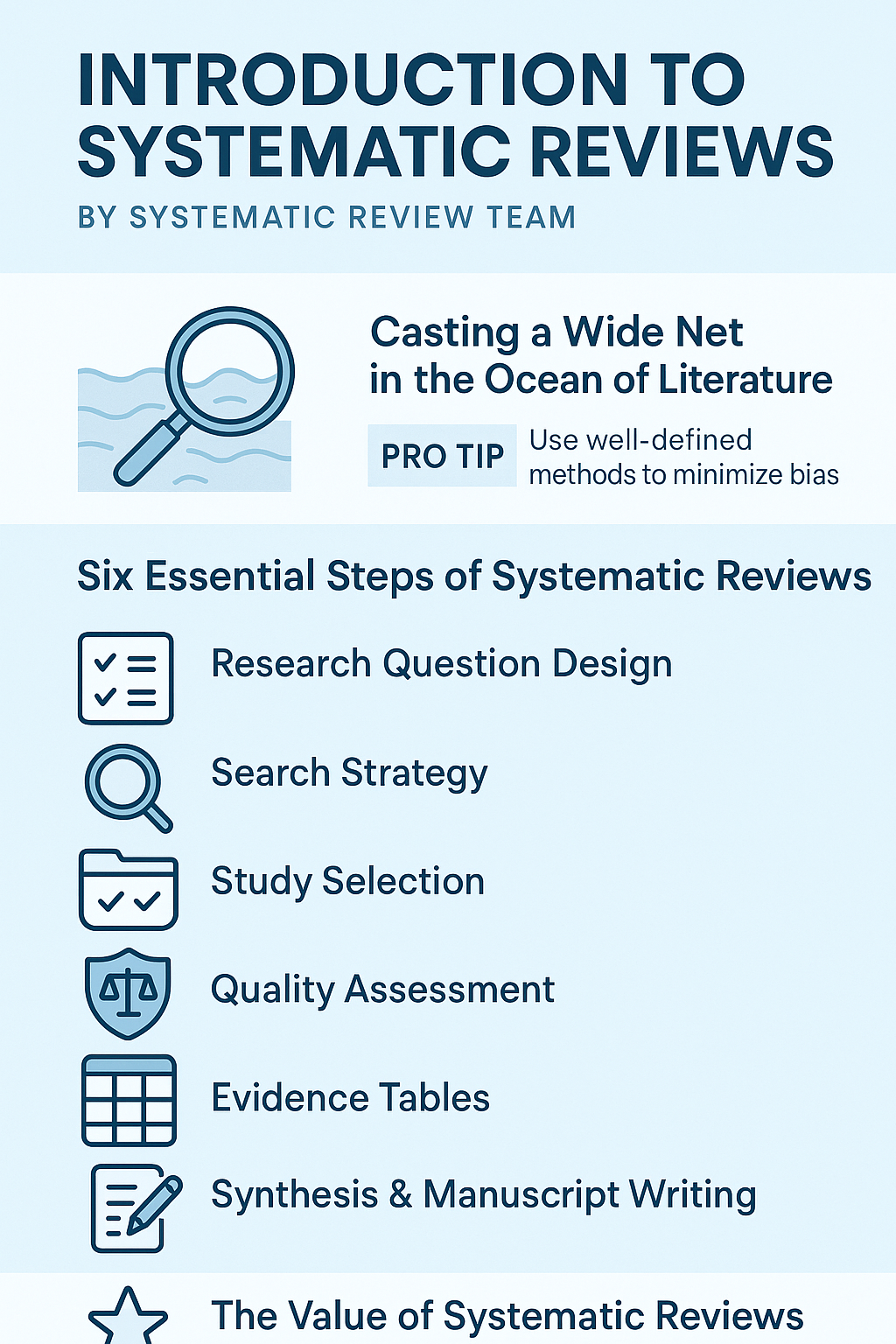
2️⃣ Search Strategy Development
The search strategy is the heart of your systematic review. It involves:
- Identifying relevant keywords and search terms
- Constructing complex search strings with Boolean operators
- Translating search strings across multiple databases (PubMed, Scopus, Web of Science, etc.)
- Searching grey literature and other non-traditional sources
- Pooling all metadata into a unified dataset
The goal is exhaustive coverage,finding every relevant study that could potentially answer your research question.
3️⃣ Study Selection Process
With your initial pool of studies collected, the selection phase begins:
- Create clear inclusion and exclusion criteria
- Conduct title and abstract screening
- Perform full-text review of potentially relevant studies
- Resolve disagreements through consensus or a third reviewer
- Document the entire process in a PRISMA flow diagram
This meticulous screening ensures only the most relevant studies progress to the next stage.
4️⃣ Quality Assessment
Not all studies are created equal. The quality assessment step evaluates:
- Risk of bias in individual studies
- Methodological quality using validated tools
- Reporting quality against established standards
This critical appraisal helps contextualize the strength of the evidence base.
5️⃣ Data Extraction & Evidence Table Building
For included studies, extract key data points:
- Study characteristics (author, year, location, design)
- Participant information
- Interventions and comparators
- Outcome measures and results
- Other relevant findings
Organize this information into evidence tables that facilitate comparison across studies and form the foundation for your analysis.
6️⃣ Synthesis and Manuscript Writing
The final step brings everything together:
- Synthesize findings across studies (narrative, qualitative, or quantitative)
- Conduct meta-analysis if appropriate
- Assess the strength of the evidence
- Develop conclusions and recommendations
- Write and publish your systematic review manuscript
🌟 The Value of Systematic Reviews
Systematic reviews represent the pinnacle of evidence synthesis. They provide:
- Comprehensive summaries of existing evidence
- Minimization of bias through transparent methods
- Identification of research gaps
- Robust foundations for clinical guidelines and policy decisions
By following these six essential steps, researchers can produce high-quality systematic reviews that advance knowledge and improve practice in their fields.

About the Author
Connect on LinkedInGeorge Burchell
George Burchell is a specialist in systematic literature reviews and scientific evidence synthesis with significant expertise in integrating advanced AI technologies and automation tools into the research process. With over four years of consulting and practical experience, he has developed and led multiple projects focused on accelerating and refining the workflow for systematic reviews within medical and scientific research.