- Tools
- 5 min read
- By George Burchell
- View publications on PubMed
- ORCID
The Mission: Automating evidence synthesis with AI
🤖 Research Question Decomposition with Large Language Models
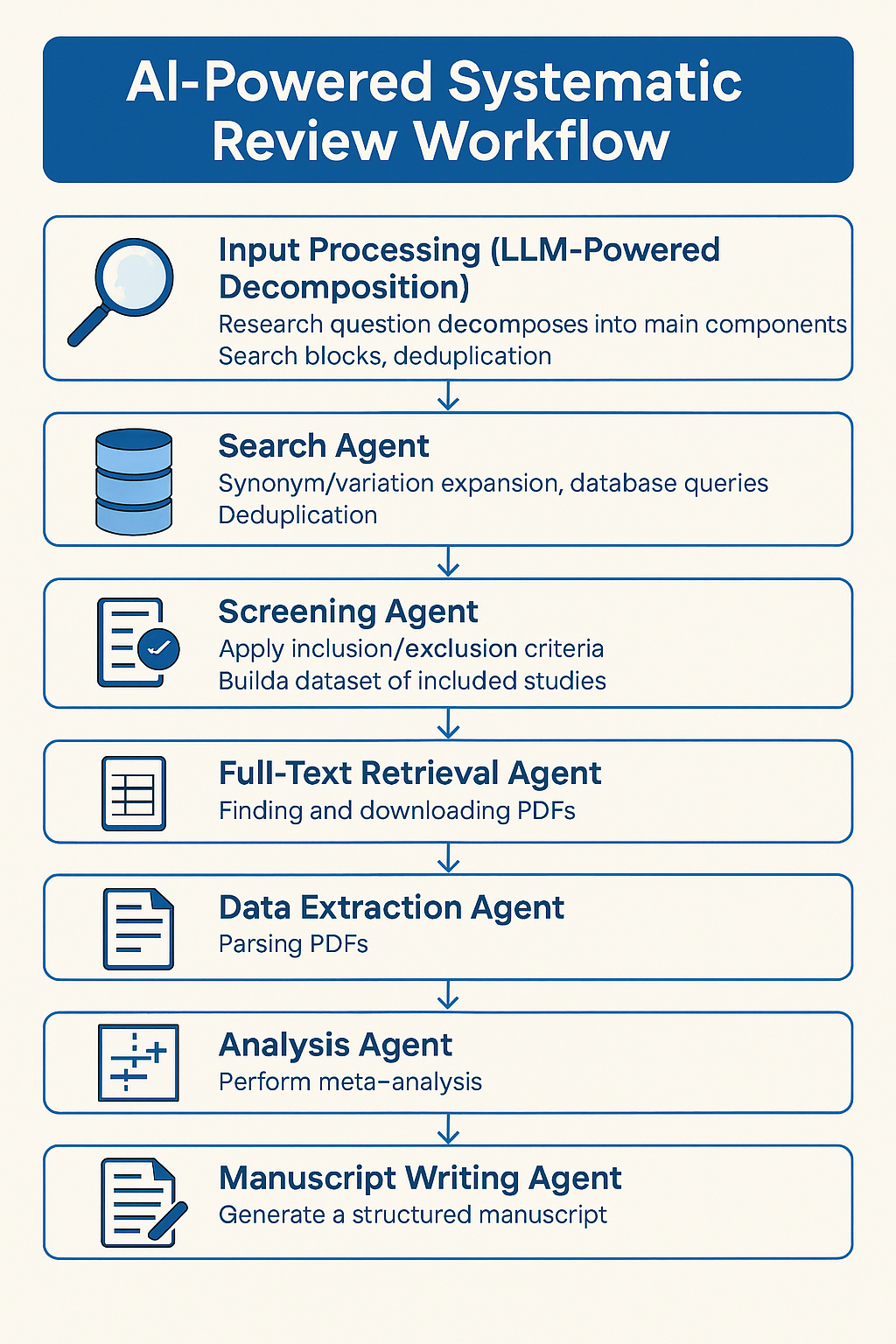
The journey of an automated systematic review begins with a well-defined research question. Modern large language models (LLMs) like ChatGPT can break down this question into its main components,population, intervention, comparison, and outcome (PICO), or other relevant frameworks.
💡 Pro Tip: Collaborate with AI to brainstorm synonyms and related terms for your search blocks!
🚀 Automated Search Strategy Generation and Expansion
Once the research question is parsed, LLMs can generate sophisticated search strings. But the process doesn't stop there. Autonomous agents can iteratively expand the search strategy, identifying synonyms, related terms, and variations to ensure comprehensive coverage. This dynamic, AI-driven approach surpasses static, manual search string development.
Seamless Integration with Global Databases and Journals
Imagine a future where these agents are connected via APIs to all major research databases and journals worldwide. The system automatically queries each source, retrieves all relevant studies, and compiles the metadata into a unified dataset. This eliminates the need for manual database searching and ensures no relevant study is missed.
Automated Deduplication and Study Selection
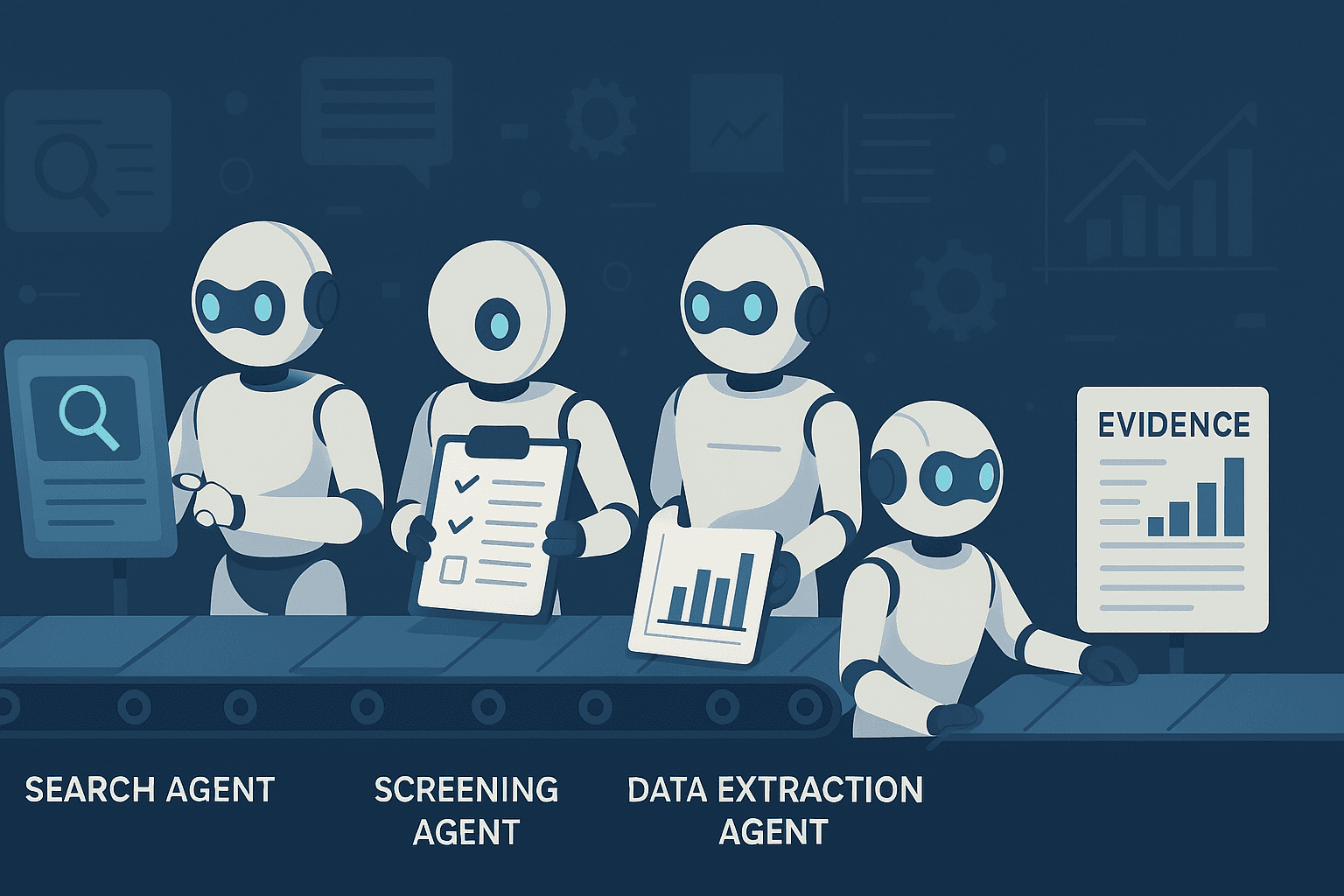
With all results in hand, the system performs deduplication to remove overlapping records. Next, another AI agent applies inclusion and exclusion criteria to each study, deciding which articles should move forward in the review. This step, traditionally labor-intensive, becomes rapid and consistent with automation.
Full-Text Retrieval and Data Extraction
For included studies, the system automatically locates and downloads the full-text PDFs. Advanced AI models then extract key data points,study characteristics, results, and more,directly from the documents. This information is structured into an evidence table or Excel sheet for further analysis.
Automated Analysis and Manuscript Writing
With all data extracted, the system can perform statistical analyses and generate summary tables and figures. Finally, leveraging LLMs, the system drafts the systematic review manuscript, ensuring adherence to reporting guidelines and best practices.
The Vision: End-to-End Automation for Evidence Synthesis
The future of automated literature searches and systematic reviews is an end-to-end pipeline,from research question to published paper,powered by AI, LLMs, and seamless data integration. This vision promises faster, more comprehensive, and less biased evidence synthesis, accelerating the translation of research into practice.

About the Author
Connect on LinkedInGeorge Burchell
George Burchell is a specialist in systematic literature reviews and scientific evidence synthesis with significant expertise in integrating advanced AI technologies and automation tools into the research process. With over four years of consulting and practical experience, he has developed and led multiple projects focused on accelerating and refining the workflow for systematic reviews within medical and scientific research.