- systematic review
- 3 min read
- By George Burchell
- View publications on PubMed
- ORCID
Translate a PubMed search block without breaking Embase, Cochrane, or WoS
A finished PubMed block is not a finished multi-database search. Paste it into Embase.com, Ovid, Web of Science, or Cochrane and the syntax fails in quiet ways: the wrong fields fire, phrases fall apart, and “Map to preferred term” invents an Emtree heading you never chose.
This is the human check that sits next to SRT’s Search Translator. The tool speeds free-text conversion. It does not replace looking up thesaurus terms. Teaching source: Academy Course 1 lesson 3.3 — this post is the scannable table, not a transcript dump.
Interface is not the database
Ovid Embase and Embase.com are the same database behind different query languages. EBSCO CINAHL is not PubMed with different colours. Translate for the platform you actually open, not for the brand name on the vendor slide.
If your protocol says “Embase via Ovid,” do not ship Embase.com field tags into the appendix and call it done.
Field tags that usually transfer
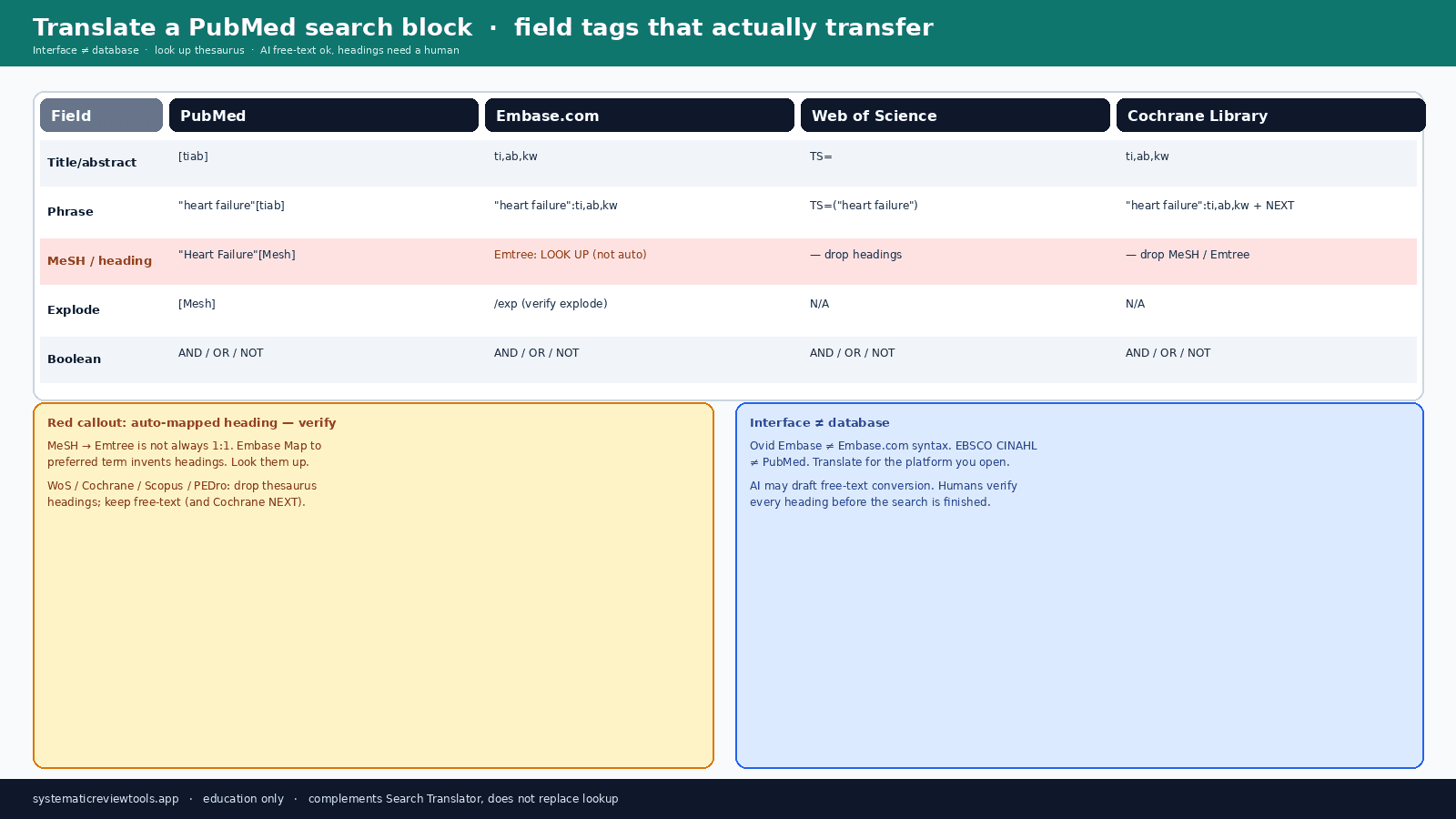
Start from a PubMed title/abstract block and rewrite the tags. Example pattern for one concept:
| Field | PubMed | Embase.com | Web of Science | Cochrane Library |
|---|---|---|---|---|
| Title/abstract | [tiab] | ti,ab,kw | TS= | ti,ab,kw |
| Phrase | "heart failure"[tiab] | "heart failure":ti,ab,kw | TS=("heart failure") | "heart failure":ti,ab,kw and use NEXT for adjacency |
| Boolean | AND / OR / NOT | same | same | same |
Keep free-text lines. Do not silently drop synonyms because the new interface feels crowded.
Thesaurus is the part that breaks
MeSH → Emtree is not always 1:1. Embase’s auto-map will happily attach a preferred term you did not validate. That is not a translation. That is an invented heading.
Rule I use:
- Look up every heading in the target thesaurus (Emtree, CINAHL headings, and so on).
- Confirm explode / narrower terms still match the protocol.
- For Web of Science, Cochrane (when you are not using MeSH in that interface), Scopus, and PEDro: drop thesaurus headings and keep the free-text block. Do not invent fake “subject” lines to feel complete.
Conflicting headings across databases are a documentation problem, not something to paper over with a single mapped term.
What AI is allowed to do
LLMs are fine for a first pass on free-text: swap [tiab] for ti,ab,kw, wrap TS=(), fix quotes. They will also invent Emtree or MeSH terms that look plausible. Treat every heading as unverified until a human opens the thesaurus.
I would rather publish a search that is free-text-only on WoS than a search that cites a heading nobody looked up.
When you are done
You should be able to show, per database: the interface used, the field-tag rewrite, which headings were looked up (or explicitly dropped), and that the Boolean structure still matches the PubMed block. That is the whole job. When the per-database blocks are locked, deduplicating multi-database search exports covers match order and the PRISMA audit before screening. The Academy video walks the demos; this table is what you keep open while you do them.

About the Author
Connect on LinkedInGeorge Burchell
George Burchell is a specialist in systematic literature reviews and scientific evidence synthesis with significant expertise in integrating advanced AI technologies and automation tools into the research process. With over four years of consulting and practical experience, he has developed and led multiple projects focused on accelerating and refining the workflow for systematic reviews within medical and scientific research.