- research gap finder
- 2 min read
- By George Burchell
- View publications on PubMed
- ORCID
Research Gap Finder: verify PubMed‑backed gaps (not AI guesses)
AI can help surface where evidence might be thin, but it can also invent confidence if you don’t check what sits behind each count. Research Gap Finder maps PubMed or uploaded citations into a matrix and proposes candidate gaps (absence, scarcity, recency, geography, study‑design). Treat those as hypotheses. An empty cell is not proof that no research exists—it can be an artefact of the search or of labels that need correcting. The working tool lives in the dashboard (sign‑in required) and the public overview is here: https://systematicreviewtools.app/tools/planning-tools/research-gap-finder.
What the tool actually does (and what it doesn’t)
- Builds an evidence map from a PubMed query or uploaded MEDLINE/RIS/CSV and keeps the query, date, and source.
- Lets you open any cell to see the classified titles and abstracts behind the count—so you can correct labels before trusting a gap.
- Generates candidate dossiers using simple, explicit rules (absence, scarcity, recency, geography, study‑design). These are starting points, not conclusions.
It does not claim that an empty cell means “no studies exist”, nor does it replace checking PubMed directly.
A concrete failure mode to watch for
An “empty” cell can appear because your PubMed query was too narrow or because records were misclassified. The marketing page makes this explicit: empty cells are not proof that no research exists, and you should inspect counts and correct labels. In practice, that means:
- Open the cell and read the underlying titles/abstracts (if any) to see whether classification or scope is off.
- Re‑run a quick PubMed check with obvious synonyms or broader field terms. If relevant studies appear there, the cell was empty due to search scope, not a true gap.
A simple verification loop
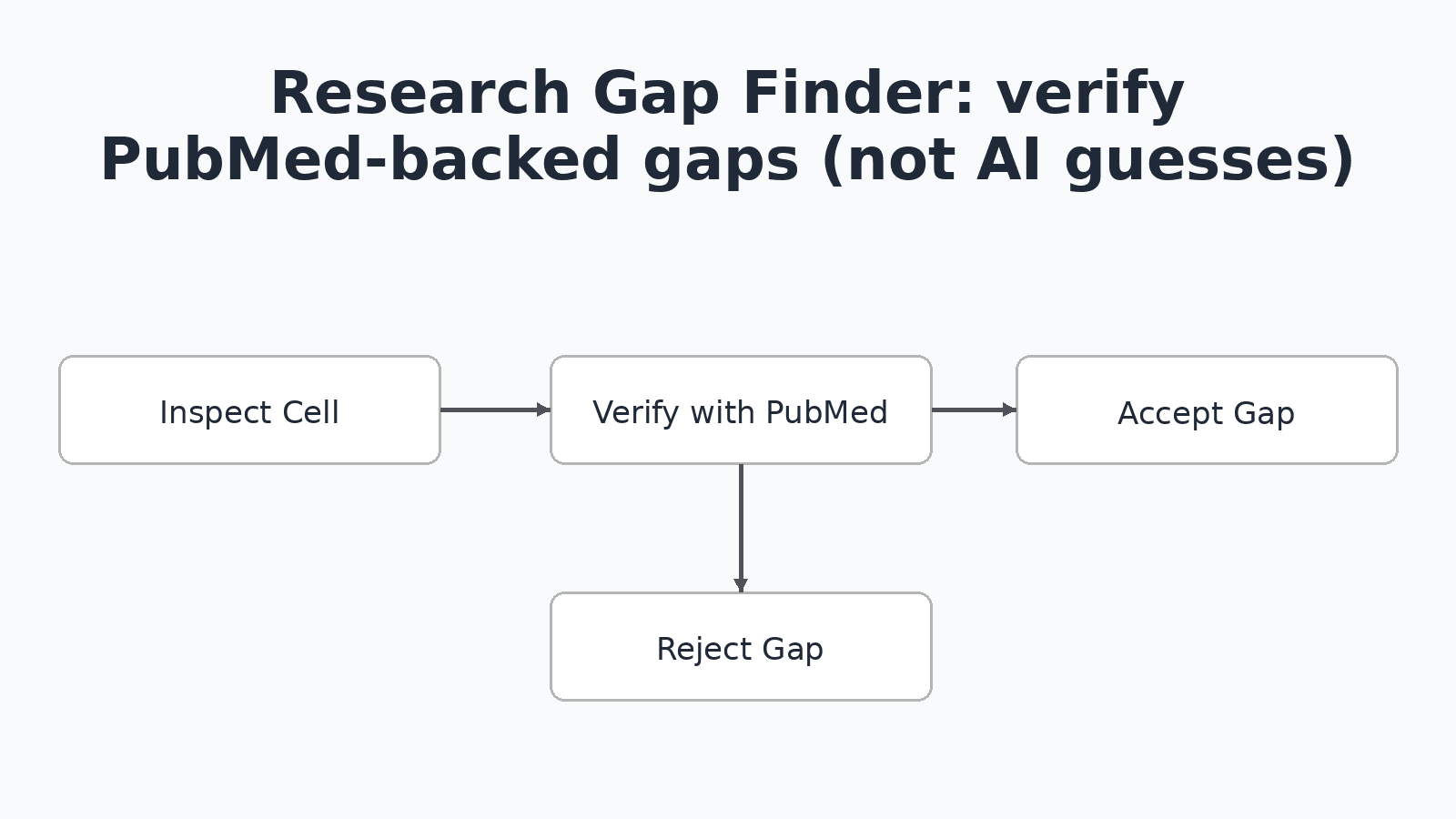
Question → run PubMed or upload citations → inspect the evidence map → open cells and correct labels → review candidate dossiers → verify against PubMed/evidence → accept or reject the “gap”.
That’s the standard I hold in my own reviews: AI prepares candidates; confidence comes from verifying them against the literature.
– George Burchell

About the Author
Connect on LinkedInGeorge Burchell
George Burchell is a specialist in systematic literature reviews and scientific evidence synthesis with significant expertise in integrating advanced AI technologies and automation tools into the research process. With over four years of consulting and practical experience, he has developed and led multiple projects focused on accelerating and refining the workflow for systematic reviews within medical and scientific research.