- PROSPERO registration
- 6 min read
- By George Burchell
- View publications on PubMed
- ORCID
PROSPERO registration: how and when to register a systematic review
PROSPERO (International Prospective Register of Systematic Reviews) is the public registry for systematic review protocols. You should register once your protocol is near-final, and crucially before you begin data extraction — PROSPERO rejects registrations if data extraction has already started (Eligibility). “Ready” means you can describe your question (PICO/PEO), eligibility criteria, search methods, selection and data-extraction process, risk-of-bias approach, and synthesis plan in clear, specific terms. Registering early creates a time-stamped record that reduces bias and prevents duplicate effort.
If you need a quick refresher on terms, see the glossary of SLR terminology. New to the workflow? Start with the quick-start guide. If you are still drafting your protocol, the SRT protocol development tool can help you structure the core sections you will enter into PROSPERO.
Why PROSPERO Registration Matters
Guarding Against Reporting Bias
One of PROSPERO's primary functions is to create a public, time-stamped record of your planned methods before you begin data extraction. This prospective registration helps prevent:
- Selective outcome reporting - When researchers only report findings that support their hypotheses
- Post-hoc outcome switching - Changing planned outcomes based on what the data shows
- HARKing (Hypothesizing After Results are Known) - Presenting exploratory findings as if they were planned from the start
By registering your protocol early, you establish a clear record of your intended methods, making any deviations transparent and accountable.
Preventing Unnecessary Duplication
Research waste is a significant problem in academia. PROSPERO helps address this by:
- Making ongoing work visible to other research teams
- Allowing stakeholders to track relevant reviews in their field
- Supporting efficient use of research funding by avoiding redundant efforts
- Enabling collaboration between teams working on similar topics
Meeting Modern Research Standards
Registration is increasingly expected by:
- Funding bodies who want to ensure research efficiency
- Academic journals that require protocol registration for publication
- Professional organizations promoting research transparency
- Systematic review guidelines like PRISMA and Cochrane standards
What You Need Before Registration
PROSPERO requires a near-final protocol that demonstrates you've thought through your review methodology. Here's what you need to have ready:
Core Protocol Elements
Review Question and Background
- Clear, focused question using PICO/PEO framework
- Comprehensive background justifying the review's importance
- Specific objectives and scope
Eligibility Criteria
- Population: Who will be included (age, condition, setting)
- Intervention/Exposure: What treatments or exposures you're studying
- Comparator: What comparison groups you'll use
- Outcomes: Primary and secondary measures
- Study Designs: Types of research you'll include
- Settings: Geographic or institutional boundaries
Search Strategy
- Databases you'll search (PubMed, Cochrane, Web of Science, etc.)
- Date limits and language restrictions
- Grey literature sources
- Supplementary search methods (reference checking, expert consultation)
Outcomes and Analysis Plan
- Primary and secondary outcomes with clear definitions
- Planned subgroup analyses or sensitivity analyses
- Statistical methods for meta-analysis (if applicable)
- Risk of bias assessment tools
- Data synthesis approach (narrative, quantitative, or mixed methods)
PROSPERO's Core Dataset
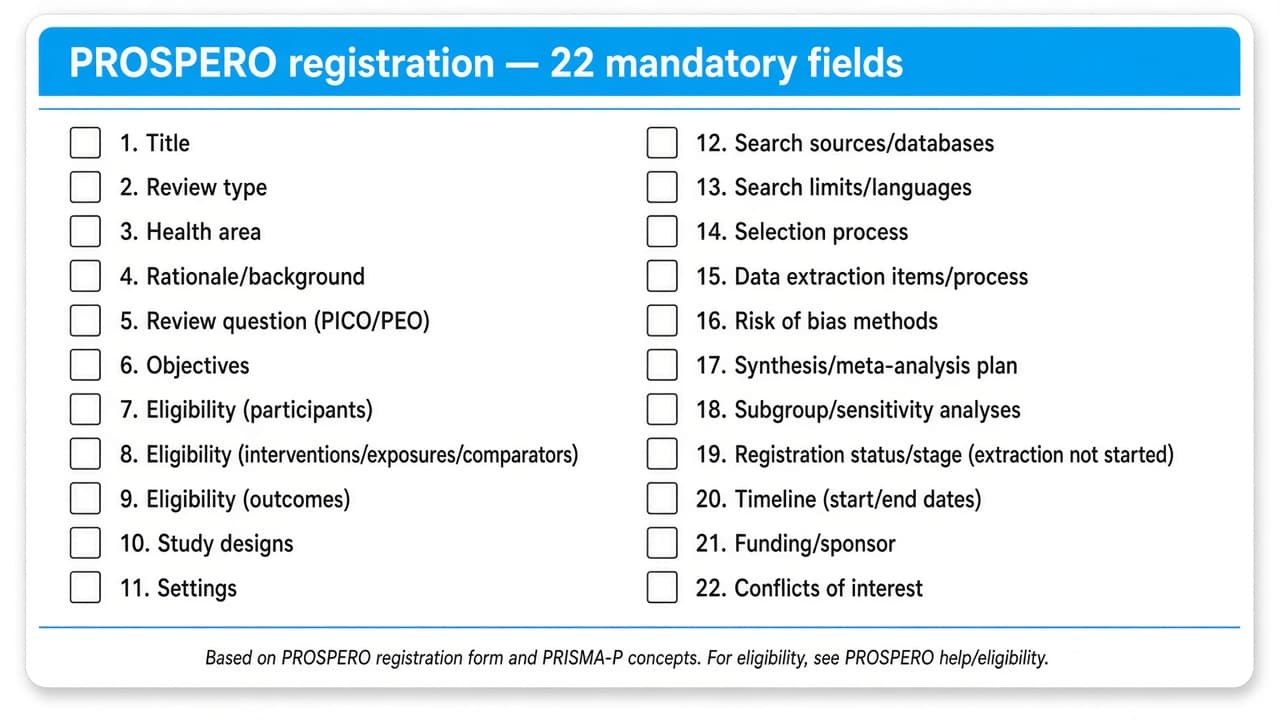
PROSPERO requires completion of 22 mandatory fields covering:
- Administrative details (title, dates, funding)
- Review question and objectives
- Methods (eligibility, search, selection, data extraction)
- Analysis plan and risk assessment
- Dissemination plans
An additional 18 optional fields allow you to provide more detail about complex reviews.
Step-by-Step Registration Process
Step 1: Prepare Your Account
Visit the PROSPERO website and create a free account. You'll need to provide basic contact information and institutional affiliation.
Step 2: Start Your Registration
Log in and click "Start a new registration." You'll be guided through the form systematically.
Step 3: Complete Administrative Fields
Fill in essential details:
- Review title (clear and descriptive)
- Anticipated start/completion dates
- Current review stage (must be pre-data extraction)
- Funding sources and potential conflicts of interest
- Team members and their roles
Step 4: Enter Methodological Details
This is where the detailed protocol information goes:
- Review question in PICO/PEO format
- Eligibility criteria with clear inclusion/exclusion rules
- Search methods including full search strings
- Data extraction plan - how you'll collect information from included studies
- Risk of bias assessment - which tools you'll use
- Synthesis methods - statistical approaches for meta-analysis
Aim for concise but comprehensive descriptions (typically 300-500 words per major section). Use structured formats with bullet points where appropriate.
Step 5: Submit and publish
Submit your completed form. PROSPERO carries out automatic checks as you enter data. A named guarantor must approve the record, and all named team members must confirm participation. Once those confirmations are completed, a registration number is assigned and the record is published immediately — there is no delay to publication (Register).
You can cite the assigned CRD number (for example, “CRD42023XXXXXX”) in your manuscript and protocol.
Managing Your Protocol After Registration
Handling Protocol Changes
Research protocols sometimes need adjustment based on real-world considerations. If you must deviate from your registered plan:
- Document all changes with clear justifications
- Update your PROSPERO record to maintain transparency
- Report deviations in your final publication
- Consider amendments for major changes (PROSPERO allows updates)
Linking to Final Publications
When you complete your review:
- Cite your PROSPERO registration in the published manuscript
- Include the CRD number in your PRISMA flow diagram
- Reference the protocol in your methods section
- Upload final results to PROSPERO if desired
Common Challenges and Solutions
Challenge: Getting Started
Solution: Use PROSPERO's online guidance and templates. Many institutions provide protocol development support. The SRT protocol development tool can also help you structure the fields PROSPERO requires.
Challenge: Keeping Within Word Limits
Solution: Focus on essential details. Use appendices for complex search strings or detailed analysis plans.
Challenge: Timing Your Registration
Solution: Register as early as possible but ensure your protocol is sufficiently developed. Remember: PROSPERO rejects records if data extraction has already started (Eligibility).
Challenge: Managing Team Contributions
Solution: Clearly define roles in the registration and ensure all team members review the final submission.
The Future of Protocol Registration
As research transparency becomes increasingly important, protocol registration is likely to become mandatory for more journals and funders. PROSPERO continues to evolve, with plans for enhanced search functionality, integration with other registries, and improved user experience.
By registering your systematic review protocol with PROSPERO, you're not just following best practices—you're contributing to a more transparent, efficient, and credible research ecosystem. The time investment in proper registration pays dividends throughout your review process and beyond.
Resources:
- PROSPERO website: crd.york.ac.uk/prospero
- PRISMA-P guidelines for protocol reporting
- Cochrane Handbook: Chapter on protocol development

About the Author
Connect on LinkedInGeorge Burchell
George Burchell is a specialist in systematic literature reviews and scientific evidence synthesis with significant expertise in integrating advanced AI technologies and automation tools into the research process. With over four years of consulting and practical experience, he has developed and led multiple projects focused on accelerating and refining the workflow for systematic reviews within medical and scientific research.